
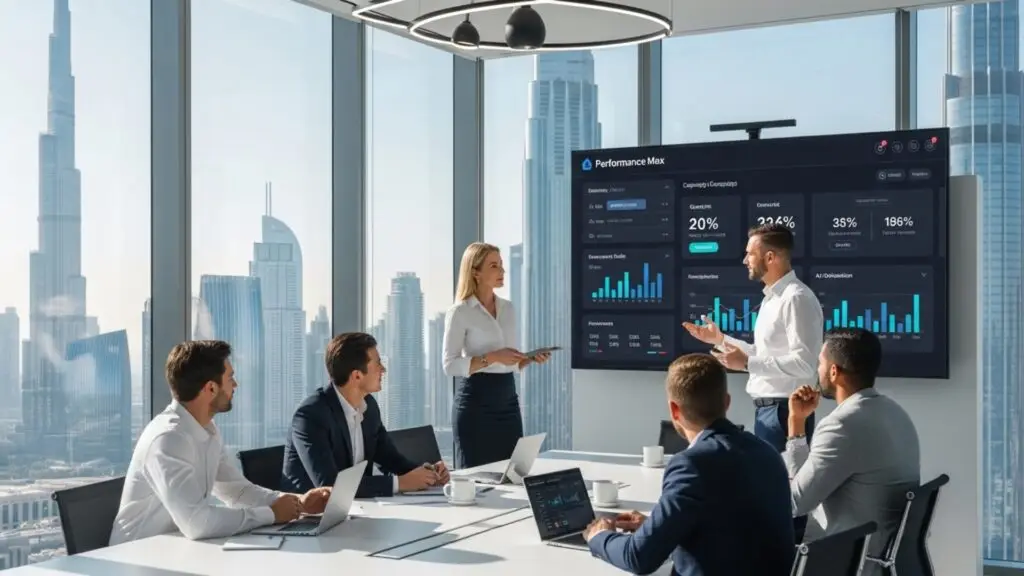
A lot has changed in digital advertising over the last few years. As Google shifts toward AI-driven campaign management, Performance Max has emerged as one of the most powerful tools for businesses looking to grow their online presence. At Hala Technology, we specialize in helping service-based businesses across the Dubai build campaigns that convert real traffic into real clients, and staying competitive in 2026 means mastering the right Performance Max strategies.
PMax, short for Performance Max, is a campaign type that runs across all of Google’s channels, Search, Display, YouTube, Gmail, Discover, and Maps. While this gives advertisers exceptional reach, budgets can drain quickly with little return if campaigns aren’t set up and managed correctly. This guide covers the highest-impact optimization strategies for 2026, so your business gets the results it deserves.
What is Performance Max, and why is it important in 2026?
It’s important to know what Performance Max really does before we start thinking about strategies. Instead of Smart Shopping and Local campaigns, Google made PMax. It uses machine learning to figure out where and when to show our ads, which groups of people to target, and which creative combinations work best. Google has kept adding to PMax’s features since 2026, giving advertisers more control signals while keeping the automation that makes it work well at scale.
PMax is especially useful for service-based businesses because it tracks demand at every step of the buyer’s journey. A potential customer might first see our brand on YouTube, then look for our service on Google, and finally click on a Display ad before making a purchase.
How to Plan and Set Up our Campaign
The first step to success is to build a strong base. Our results will stay weak if our campaign structure is weak. First, divide our campaigns into groups based on their goals. Don’t put more than one type of product or service in a single campaign. Make sure that each campaign has a clear goal, such as getting leads, making sales, or making reservations.
Also, make sure our asset groups are set up correctly. Each group of assets should be based on a certain theme or type of product. This makes it easier for Google to show ads to the right people. A clear structure makes machine learning work better and help us grow faster.
Audience Signals Optimization
Audience signals guide Google’s AI in the right direction. They help the system understand our ideal customers and speed up the learning process. Many advertisers ignore this step, but it plays a major role in campaign success.
We should include website visitors, customer lists, custom intent audiences, and interest-based segments. These signals do not limit our reach but instead help Google find better-quality users faster. Over time, the system expands and finds more people similar to our best customers. Proper audience setup is essential for achieving strong conversion performance.
Feed Optimization for E-commerce Success
If we run an e-commerce business, our product feed is the backbone of our campaign.
To improve feed performance:
- Use clear product titles with keywords
- Add high-quality product images
- Update pricing regularly
- Remove out-of-stock products
- Add detailed product descriptions
Google uses our feed data to match searches with our products. A clean and optimized feed increases visibility and conversions.
AI-Driven Audience Targeting for Smarter Campaign Performance
Understanding AI-Driven Audience Targeting
AI-driven audience targeting is one of the most important parts of modern Google Ads campaigns, especially in Performance Max. It uses machine learning to study user behavior, search patterns, and online activity to find people who are most likely to convert. Instead of manually selecting every audience, Google’s AI automatically analyzes data and improves targeting over time. This makes campaigns more efficient and reduces wasted ad spend while increasing conversion quality.
How Google AI Learns our Ideal Audience
Google AI learns our ideal audience by analyzing signals from our website, ads, and conversion history. It studies who visits our site, what actions they take, and which users complete valuable conversions. Over time, it builds a pattern of our best customers and starts finding similar users across Google platforms. This learning process becomes stronger when we provide high-quality audience signals and accurate conversion tracking.
Importance of Strong Audience Signals
Strong audience signals help guide the AI in the right direction. These signals include past customers, website visitors, and users who interacted with our ads. When we provide clear and relevant signals, Google understands our business faster and improves targeting accuracy. Without strong signals, the system may take longer to optimize or target less relevant users.
Improving Campaign Performance with AI Targeting
AI-driven targeting improves campaign performance by focusing on users who are more likely to take action. It reduces irrelevant traffic and increases the chances of conversions. This leads to better return on ad spend and more efficient budget use. As the system learns, it continuously refines targeting, making our campaigns smarter and more profitable over time.
Best Practices for Smarter Audience Optimization
To get better results, always combine different audience types such as remarketing lists, custom segments, and customer data. Keep our conversion tracking accurate and updated so AI can learn correctly. Also, avoid limiting our audience too much, as Google needs flexibility to explore and optimize. A balanced approach helps achieve consistent and scalable performance.
Landing Page Optimization
Even if our ads perform well, a weak landing page can reduce conversions. Our landing page must match our ad message and provide a smooth user experience. A good landing page should load quickly, work perfectly on mobile devices, and include clear calls-to-action. It should also build trust through reviews, testimonials, and clear information. When our landing page is optimized, our conversion rate naturally improves.
Bidding Strategy Optimization
Bidding strategy is another important factor in Performance Max success. Google offers smart bidding options like Maximize Conversions, Target CPA, and Target ROAS. Choosing the right bidding strategy depends on our business goals. We should avoid changing bidding strategies frequently because it resets the learning phase. Instead, allow the system enough time to optimize and collect data. Stable bidding strategies deliver more consistent results over time.
Create Diverse and High-Quality Creative Assets
Google’s AI needs variety to find what works. If we give it only two or three headlines and one image, it has very little room to test and optimize. In 2026, filling every asset slot to the maximum allowed is one of the most straightforward ways to improve PMax performance. Google assigns an asset group strength score from Poor to Excellent, and campaigns with Excellent-rated asset groups consistently outperform those with lower scores.
Here is what strong creative assets look like for a service-based business:
- Headlines that address specific pain points our service solves, written in clear and direct language
- Descriptions that explain our unique value proposition and include a strong call to action
- High-resolution images that show our team, our work, or our service in action not generic stock photos
- A short video (even 30 seconds) explaining what our business does and why clients should choose us
- our logo and brand colors used consistently across all visual assets to build recognition
At Hala Technology, we help clients develop creative assets that not only meet Google’s requirements but actually resonate with their target audience. Strong creative is one of the highest-impact levers we have control over inside a PMax campaign.
Data Analysis and Continuous Optimization
Performance Max is not a one-time setup campaign. It requires continuous monitoring and improvement. We should regularly analyze campaign data to identify what is working and what needs improvement. Focus on metrics like conversion rate, cost per conversion, and asset performance. Use this data to refine our creatives, improve audience signals, and adjust our campaign structure. Continuous optimization ensures long-term success.
Scaling Performance Max Campaigns
Once our campaign is stable, we can start scaling.
Scale by:
- Increasing budget slowly
- Adding new asset groups
- Expanding audience signals
- Testing new creatives
- Launching new campaigns for different products
Avoid sudden changes. Scaling should be gradual and controlled.
Advanced Optimization Techniques
To stay ahead in 2026, we must apply advanced strategies beyond basic setup. This includes using first-party data, improving product feeds, testing multiple creative variations, and integrating offline conversions. These advanced techniques give us a competitive advantage and help us scale campaigns more effectively. Businesses that use these methods often achieve lower costs and higher returns.
How Hala Technology Helps Service Businesses Win With Performance Max
At Hala Technology we specialize in Digital Marketing solutions for service-based businesses across the UAE. Our approach to Performance Max is built on years of hands-on campaign management experience combined with a deep understanding of how UAE consumers search for and select service providers.
Every campaign we manage starts with a thorough audit of our current digital presence, our conversion tracking setup, and our competitive landscape. We then build a custom PMax strategy based on our specific business goals, whether that is generating more service inquiries, increasing appointment bookings, or driving more calls from qualified prospects.
Performance Max Trends to Watch in the Second Half of 2026
Google continues to roll out new features and improvements to Performance Max throughout 2026. One of the most significant trends is the increased integration of generative AI into the creative asset production process. Advertisers can now use AI-assisted tools within Google Ads to generate additional headline and description variations based on their existing content, which makes it easier to maintain a full and diverse asset group without requiring a large creative team.
Common Performance Max Mistakes That Service Businesses Must Avoid
Even with a strong strategy, certain mistakes can undermine Performance Max performance and drain advertising budgets without delivering results. One of the most common is making too many changes to the campaign before it has completed its learning phase. Every significant change, a budget increase of more than 20%, a bidding strategy change, or a major asset group revision, restarts the learning phase. Advertisers who constantly tweak their campaigns end up in a cycle where the campaign never fully optimizes.
Another frequent mistake is ignoring the asset performance report, which shows how individual headlines, descriptions, and images are performing within each asset group. Google rates assets as Low, Good, or Best, and replacing Low-performing assets with new variations is one of the most direct ways to improve asset group quality and overall campaign performance. Many advertisers set up their campaigns and then forget about the creative side, missing out on significant performance improvements.
Conclusion
Performance Max is one of the most powerful advertising tools in Google Ads, but it requires the right strategy to deliver strong results. By applying Top Performance Max Optimization Strategies for 2026, we can improve targeting, reduce wasted budget, and increase conversions effectively.
Success in Performance Max comes from combining automation with smart human strategy. If we focus on structure, data, creatives, and continuous optimization, our campaigns will perform at a much higher level and deliver long-term business growth. At Hala Technology, we are dedicated to helping service based businesses across the UAE build and manage PMax campaigns that deliver real, measurable growth. Whether we are new to Performance Max or looking to improve the performance of an existing campaign, our team of digital advertising specialists is ready to help.